
For many accredited investors, a portion of their portfolio sits in fixed deposits, doing the safe, predictable work of preserving capital while generating stable, modest returns. While this offers predictability, and lower risk, their rates have struggled to keep pace with inflation and returns available from other short-term investment options in the market.
In today's market environment, where yield opportunities across the capital stack have expanded considerably, leaving excess liquidity parked in traditional bank deposits such as saving accounts and fixed deposits may result in a more conservative return profile. This has led investors towards higher risk short-term instruments which are commonly used to manage liquidity, preserve capital, and potentially enhance returns on idle cash during a shorter investment horizon.
What is a short-term instrument?
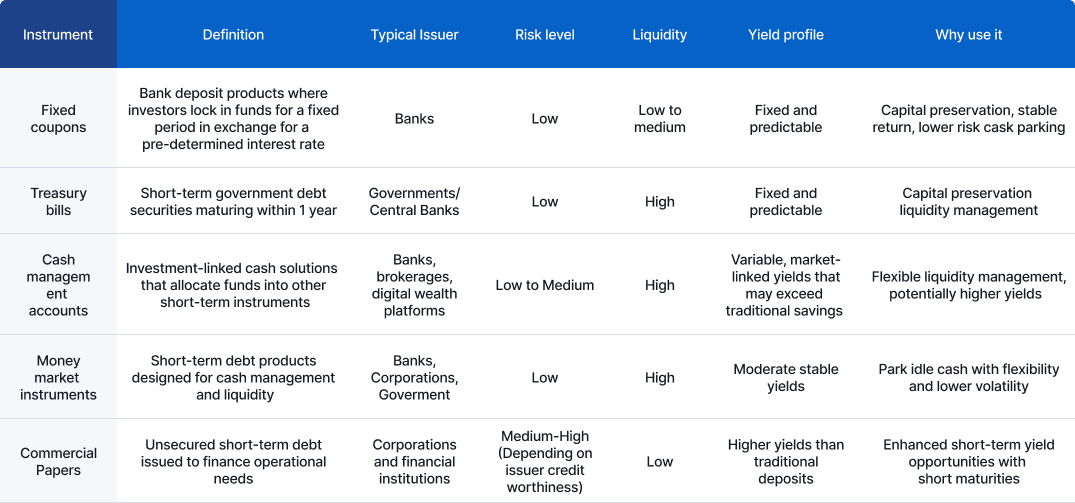
At its core, a short-term debt instrument is any fixed-income security with a maturity of one year or less. This includes treasury bills, short-duration bonds, money market instruments, and notably, commercial papers issued by corporations and financial institutions.1 The table below defines and differentiates various short-term instruments.
Why consider investing in a short-term instrument?
- Some short-term instruments may offer yields above conventional fixed deposits or standard savings accounts, maximising your returns from idle cash.
- Many short-term instruments mature within months to a year, allowing investors to access capital at maturity and redeploy it into new opportunities.
- Due to their shorter duration, short-term instruments are generally less sensitive to interest rate movements.
- Short-term instruments can provide a relatively lower-volatility component within a portfolio, particularly when compared to higher-risk asset classes such as private equity or venture capital.
- Accredited investors with existing cash holdings may use short-term instruments to manage their liquidity needs and reduce idle cash.
Traditional short-term instruments: Fixed deposits and treasury bills
For many investors, fixed deposits and government-backed securities act as the starting point for managing short-term cash. These instruments tend to be lower-risk options for preserving capital, while generating modest returns. The differences in each of these instruments lie in their liquidity, yield structure, and flexibility.
What are fixed deposits?
Fixed deposits (FDs) are bank deposit products that allow investors to lock in their funds for a fixed period with returns following a fixed interest rate. The investment horizon for FDs can range from a few months to several years.
Given the certainty of returns, fixed deposits are commonly used by investors seeking to preserve capital and earn predictable returns. However, these funds are generally less liquid during the lock-in period, and early withdrawals may lead to penalties or reduced interest payments. 2
What are T-bills?
Treasury Bills (T-Bills) are short-term government securities that mature within 1 year. Unlike fixed deposits, T-Bills are purchased at a discount, with investors receiving the full amount upon maturity. As they are backed by the government, they tend to have lower credit risk. 3
Why are investors looking beyond traditional short-term instruments, fixed deposits, and T-bills?
In Singapore, benchmark fixed deposit rates at major banks have historically trailed corporate short-term yields by a considerable margin. As of 2025, the national average fixed deposit rate sat at approximately 2.53% per annum, with promotional rates from major banks ranging between 2.50% and 2.90% per annum. 4
For accredited investors who have access to institutional-grade markets, this means an opportunity to earn returns above the threshold of traditional investments.
Market-based cash management solutions: Cash management accounts and money market funds
While traditional instruments such as fixed deposits and treasury bills are widely adopted due to their lower risk, some investors now prefer market-based cash solutions that offer greater flexibility and higher yield opportunities. These products include cash management solutions and money market funds, which invest in underlying market instruments instead of offering a fixed, guaranteed return rate. Despite this, these products are still designed to preserve capital and deliver steady returns by allocating funds towards high quality, shorter duration debt securities.
What are cash management accounts?
Cash management accounts (CMAs) are investment-linked cash solutions designed to help investors earn returns on idle cash while maintaining relatively high liquidity. These accounts are typically offered by banks, brokerages, and digital wealth platforms who allocate these funds into other short-term instruments such as money market funds, short-term government securities, and other short-term debt products.
Unlike traditional short-term instruments, returns from CMAs may fluctuate depending on market conditions and interest rates. Nonetheless, CMAs are structured to prioritise stability, and liquidity over high yields, making them suitable for short-term cash management. 5
What are money market funds?
Meanwhile, money market funds are pooled investments that invest in high-quality, short-term debt securities such as treasury bills, commercial papers, certificates of deposit, and short-term bonds. As these funds invest in market-based instruments, returns can fluctuate alongside the market. However, they are lower risk in comparison to longer duration and growth-oriented assets due to their shorter maturity, and the high credit quality of underlying assets. 6
An alternative short-term instrument: Commercial papers
What are commercial papers?
Beyond traditional instruments and market-based cash management solutions, some accredited investors may consider commercial papers as part of their short-term cash management strategy.
Commercial papers are unsecured short-term debt instruments issued by corporations, and financial institutions to fund their near-term operational needs (i.e. inventory or working capital). These instruments typically mature within a few days to 1 year and are issued by companies with strong credit profiles. 7
However, unlike traditional instruments, the yield on commercial paper is influenced by market conditions, including interest rates and the issuer’s credit quality.
Why do investors opt for commercial papers?
For accredited investors, commercial papers provide an opportunity to earn returns dependent on market conditions and issuer creditworthiness.
Compared to traditional instruments, they may offer different yield characteristics, while their shorter maturities can support liquidity management by allowing investors to access capital over a shorter investment horizon.
How ADDX improves access to commercial papers
Traditionally, access to commercial papers was limited to corporations, institutional investors, and high-net-worth individuals due to the large minimum investment and limited market accessibility. However, growing investor demand for higher yielding short-term instruments has contributed to significant growth across global money markets, and short-duration fixed-income markets in recent years.
ADDX aims to broaden access to this opportunity by providing accredited investors with commercial paper offerings from established issuers. The platform has tailored investment minimums to suit individual portfolios rather than institutional mandates, improving accessibility to commercial paper investments.

References:
1Financial Edge. Commercial Paper. https://www.fe.training/free-resources/accounting/commercial-paper/
2SingSaver. Fixed Deposits in Singapore: Beginner’s Guide to Fixed Deposits. https://www.singsaver.com.sg/banking/blog/fixed-deposit
3Syfe Singapore. Singapore T-bills explained: A complete beginner’s guide. https://www.syfe.com/magazine/complete-guide-to-singapore-treasury-bills/
4SingSaver. Best Fixed Deposit Rates in Singapore. https://www.singsaver.com.sg/banking/blog/current-fixed-deposit-singapore
5Investopedia. Cash Management Account (CMA): Definition, Uses, and Alternatives. https://www.investopedia.com/what-is-a-cash-management-account-8687007
6Investopedia. Money Market Fund: What It Is, How It Works, Pros and Cons. https://www.investopedia.com/terms/m/money-marketfund.asp
7Wall Street Prep. Commercial Paper. https://www.wallstreetprep.com/knowledge/commercial-paper/
8Investopedia. Commercial Paper: Definition, Advantages, and Example. https://www.investopedia.com/terms/c/commercialpaper.asp
Disclaimer: This page is for general informational purposes only and has not been independently verified to ensure its accuracy and fairness. This page does not constitute any advice or recommendation from ADDX or any of its affiliates. Please consult your own professional advisors about the suitability of any investment product/securities/ instruments for your investment objectives, financial situation and particular needs. No representation, warranty or other assurances of any kind, expressed or implied, is made with respect to the accuracy, completeness, adequacy, reliability validity or availability of any information in this article. Under no circumstance shall ADDX have any liability to the reader for any loss or damage of any kind incurred as a result of the use or reliance on any information provided in this page. This page may not be modified, reproduced, copied, distributed, in whole or in part and no commercial use or benefit may be derived from this article without the prior written permission of ADDX. ADDX reserve all rights to this page.