
Geopolitical volatility, tariff disruptions, and diverging monetary policies are reshaping global markets in 2026. For Singapore’s high-net-worth investors, the focus is shifting beyond growth alone towards building portfolios that can adapt across different market conditions.
The global landscape: A new era of geopolitical risk
The current environment reflects more than a typical cyclical slowdown. Leading institutions increasingly describe it as a structurally different geopolitical backdrop. Developments such as tensions in the Middle East, disruptions along key energy routes, the evolving US–China relationship, and rising trade fragmentation are becoming more persistent features of markets.
The BlackRock Investment Institute describes this moment as a “wholesale reordering of global political and economic relationships”, driven by rising trade protectionism, increased government interventions in markets, heightened global competition, and an intensifying AI race. 1 Meanwhile, the WEF Global Risks Report 2026 identifies geoeconomic confrontation as the foremost immediate risk to the global economy selected by 18% of over 1,300 surveyed experts as the risk most likely to trigger a material global crisis this year, climbing from 8th place in 2025. 2
These dynamics affect markets through multiple channels. Energy supply disruptions can contribute to inflationary pressures, while trade fragmentation may redirect capital flows and increase cost pressures for businesses. Policy uncertainty continues to weigh on investment decisions globally.
Singapore's unique position in a fragmented world
Singapore sits at the intersection of global capital flows. While its open economy makes it sensitive to global developments, it also benefits strong institutions, regulatory credibility, and its role as a regional financial hub.
The asset management industry reached approximately SGD 6.7 trillion in AUM in 2024, with a large share of capital both sourced and invested globally. 3 The continued growth of family offices further reinforces Singapore’s position as a key wealth management centre in Asia.
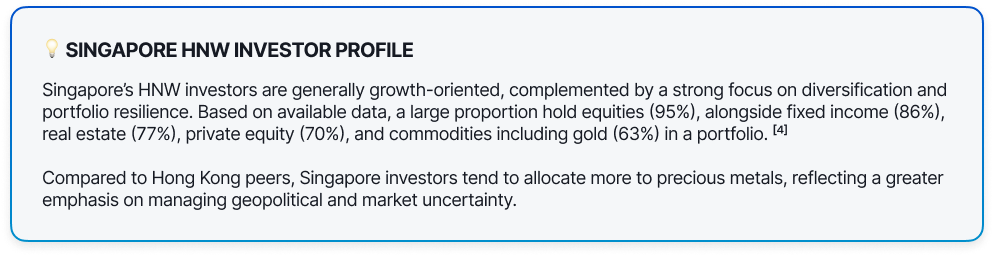
How resilient portfolios are being constructed in 2026
In a period defined by structural uncertainty rather than cyclical volatility, investors are rethinking portfolio construction. The strategies below represent the pillars of resilience being deployed by HNW allocators in 2026.
1) Strategic geographic diversification
With the US-China relationship remaining adversarial, concentration in any single geography carries elevated risk. Singapore's HNW investors are increasingly diversifying portfolios spanning developed and selected emerging markets, deliberately avoiding overexposure to any single political or trade bloc. The Bank of Singapore's 2026 Supertrends Report highlights Asia's evolution into a technology and sustainability powerhouse a structural shift that warrants meaningful long-term allocation. 5
2) Gold and commodities as geopolitical hedges
J.P. Morgan Global Research projects gold prices pushing toward $5,000/oz by Q4 2026, supported by central bank and investor demand averaging 585 tonnes a quarter. Even at elevated prices, central bank structural buying has further to run around 755 tonnes of purchases expected in 2026 alone. In Singapore, gold is widely viewed as one of several assets that investors monitor for its historical role during periods of macro or market stress. Its performance characteristics, particularly during episodes of currency volatility or heightened geopolitical tension, make it a potential tool for diversification. 6
3) Private credit: Income opportunities with contractual cash flows and structural features
As traditional banks become increasingly selective in their lending, private credit has emerged as a vital financing channel in global capital markets. For investors, it offers yield-focused returns that are largely insulated from public market volatility.
This low correlation to public markets is borne out by the data: for the period from October 1 2021 to ending September 30, 2022, private credit posted a correlation of just 0.70 against the S&P 500 Index and a near-neutral -0.15 against the Bloomberg US Aggregate Bond Index. 7
The Asia-Pacific private credit market is poised for significant growth, projected to nearly double from $59 billion in 2024 to $92 billion by 2027, representing a 16% compound annual growth rate (Hubbis). This trajectory is driven by rising investor demand for diversification, greater appetite for flexible financing solutions, and ongoing structural shifts in regional economic activity. 8
4) Selective AI and technology exposure
AI has been a dominant driver of earnings growth for the S&P 500 in recent years, with technology names responsible for a disproportionate share of incremental market returns. For investors, the opportunity lies in examining different parts of the AI supply chain while maintaining discipline on entry valuations and avoiding concentration risks.
5) Multi-currency and FX strategy
In a world of diverging monetary policies with the Federal Reserve cutting rates while the Bank of Japan tightens and the ECB maintains a cautious stance - currency management has become a material source of both risk and return. Singapore-based investors potentially benefit from holding assets denominated across SGD, USD, JPY, and EUR, with the SGD potentially providing a natural stabilising buffer. MAS's exchange-rate-centered monetary policy means the SGD remains one of Asia's most credible and stable currencies, a meaningful advantage for multi-currency portfolio construction.
6) Structured products: Harnessing volatility for defined outcomes
Periods of elevated market volatility can create favorable conditions for certain structured products, as option premiums tend to increase. For HNW investors, these instruments may offer a way to access market exposure with predefined payoff to risk profiles, depending on the structure.
In uncertain market environments, some investors explore structured products as part of broader portfolios of construction, particularly for investors seeking more defined risk-return parameters.
7) Short-term debt and commercial paper: Liquidity as a strategic asset
Volatility highlights the risks of liquidity. Short-term debt instruments, particularly high-grade commercial paper and short-duration money market instruments, serve a dual purpose: preserving capital during dislocations while keeping dry powder ready for attractive entry points. With short-term rates still elevated in 2026, investors are compensated for staying liquid.
The macro-outlook: Navigating the road ahead
According to Allianz Global Investors, global growth is expected to remain stable, supported by policy measures, resilient private-sector balance sheets, and AI-driven productivity, even as geopolitical risks persist. 9
For fixed income, the path of interest rates remains uncertain, shaped by inflation and geopolitical developments. Yields may therefore stay elevated, with investor positioning continuing to adjust alongside policy expectations.
Real estate, particularly in Singapore’s Core Central Region and well-located commercial assets, continues to attract interest as an income-generating and diversification component. Singapore’s absence of capital gains tax also supports its role in long-term wealth planning.
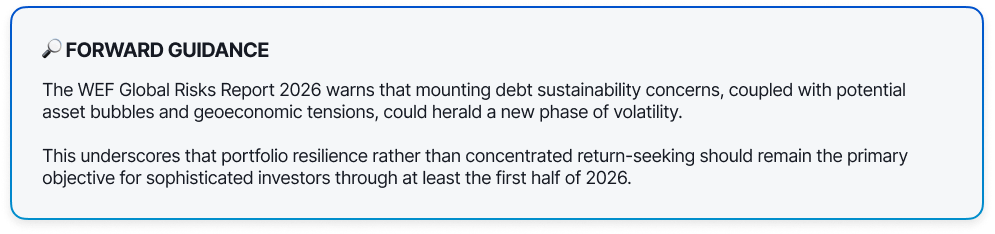
Conclusion: Resilience as the ultimate return
In today’s environment, diversification plays a central role in building resilient portfolios. Rather than relying on any single driver of returns, investors are combining multiple strategies across asset classes, geographies, and currencies.
For Singapore’s HNW investors, this approach reflects a broader shift: focusing not only on returns, but on building portfolios that can adapt across different market conditions.

References:
1 BlackRock Investment Institute (March 2026). "Geopolitical Risk Dashboard". https://www.blackrock.com/institutions/en-apac/insights/thought-leadership/blackrock-investment-institute/interactive-charts/geopolitical-risk-dashboard
2 World Economic Forum (January 2026). "Global Risks Report 2026". https://www.weforum.org/publications/global-risks-report-2026/digest/
3 Resource Group Holdings (February 2026). "Singapore Asset Management Market Trends 2026". https://www.resourcegroupholdings.com/singapore-asset-management-market-trends/
4 Capgemini. World Wealth Report 2024. https://worldwealthreport.com
5 Bank of Singapore Chief Investment Office (2026). "2026 Supertrends: Bridging Worlds; Building Whole Portfolios". https://www.bankofsingapore.com/research/2026-supertrends-bridging-worlds-building-whole-portfolios.html
6 J.P. Morgan Global Research (2025/2026). "Gold Price Forecasts: A New High?". https://www.jpmorgan.com/insights/global-research/commodities/gold-prices
7 Calamos, today for tomorrow (2023) "Pursuing an Expanded Efficient Frontier with Private Credit". https://www.calamos.com/blogs/investment-ideas/pursuing-an-expanded-efficient-frontier-with-private-credit/#:~:text=Consulting a financial advisor about your particular, measures the performance of investment grade bonds
8 Creative Planning (2026) "Private credit trends 2026: Growth outlook and opportunities" Private Credit Trends 2026: Growth Outlook and Opportunities
9 Allianz Global Investors (January 2026). "House View Q1 2026". https://www.allianzgi.com/en/insights/outlook-and-commentary/house-view-q1-2026
Disclaimer: This page is for general informational purposes only and has not been independently verified to ensure its accuracy and fairness. This page does not constitute any advice or recommendation from ADDX or any of its affiliates. Please consult your own professional advisors about the suitability of any investment product/securities/ instruments for your investment objectives, financial situation and particular needs. No representation, warranty or other assurances of any kind, expressed or implied, is made with respect to the accuracy, completeness, adequacy, reliability validity or availability of any information in this article. Under no circumstance shall ADDX have any liability to the reader for any loss or damage of any kind incurred as a result of the use or reliance on any information provided in this page. This page may not be modified, reproduced, copied, distributed, in whole or in part and no commercial use or benefit may be derived from this article without the prior written permission of ADDX. ADDX reserve all rights to this page.